Send events
Your application sends authenticated HTTP requests containing one event or a batch. You do not need to build a collection pipeline or define a destination table first.
Event analytics for 1–10 person teams
Send JSON over HTTP. Postcone creates and manages analytical tables as event shapes evolve, preserves every source event, semantically interprets the resulting data, and gives you SQL plus visualizations suggested from that understanding.
One event or a batch · No upfront table definition
curl -X POST \
"https://api.postcone.com/v1/tables/analytics.agent_runs/events" \
-H "Authorization: Bearer pcone_..." \
-H "Content-Type: application/json" \
-d '{
"run_id": "run_8f3a",
"agent": "research-bot",
"duration_ms": 1850,
"status": "success"
}'analytics.agent_runs
Created automatically
Managed as events evolve
Full source JSON retained
Semantic views + SQL
Meaning inferred from data
Ingest
Single events or batches
Manage
Tables + evolving schemas
Interpret
Semantic column analysis
Understand
Generated views + SQL
You already have the data. You should not need a data platform team to use it.
Event analytics often starts with one endpoint and becomes a queue, schema system, storage pipeline, table catalog, query engine, cache, and visualization layer. Postcone manages that path as one service so a solo developer or small product team can stay focused on the application.
Build the stack
Use Postcone
One workspace-scoped API
Send the event. Keep building your product.
Send one request. Postcone handles the layers between event and insight.
Your application emits ordinary JSON. Postcone takes responsibility for the ingestion, storage, schema, and interpretation work that normally turns event analytics into a platform project.
Your application sends authenticated HTTP requests containing one event or a batch. You do not need to build a collection pipeline or define a destination table first.
Postcone handles authenticated ingestion, buffering, analytical file creation, table storage, and publication. Your product team does not have to operate those systems.
Incoming events are examined to determine the table's columns and types. As new fields appear, Postcone evolves its schema understanding additively while retaining the complete source JSON and keeping older events available.
Postcone combines column names, physical types, statistics, and sample values to infer
semantic roles. For example, duration_ms: long can be recognized as a latency measurement rather than a currency amount, status code, or
general number field.
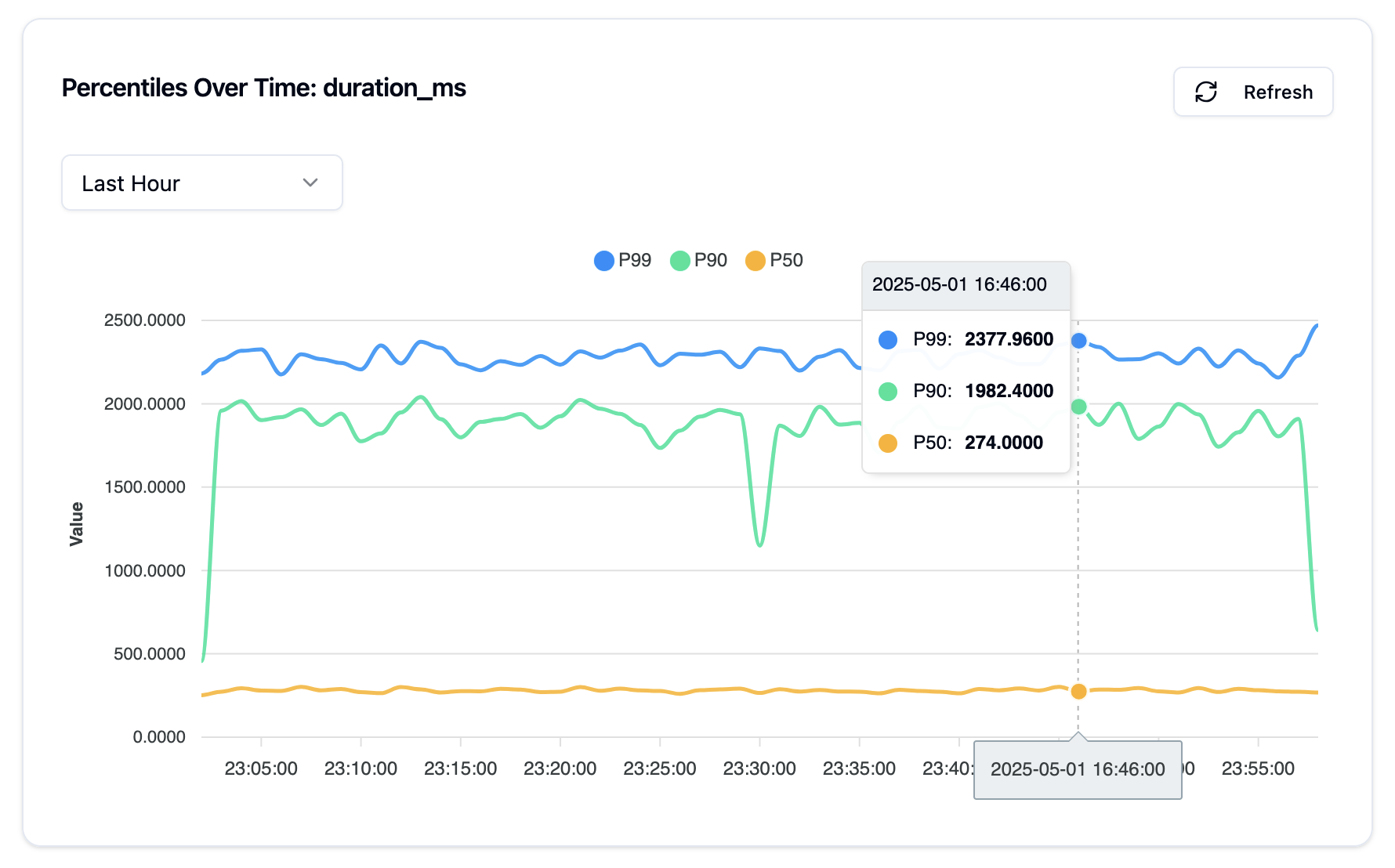
Postcone uses its semantic understanding to generate relevant suggested visualizations, such as latency percentiles over time. The underlying event tables remain directly queryable with SQL whenever you need to go deeper.
From an evolving schema to analysis that fits the data.
Postcone maintains structural understanding as event shapes change, then analyzes column names, types, statistics, and sample values to infer what those columns represent. That semantic model drives useful visualization suggestions while the underlying events remain directly queryable with SQL.
SELECT
agent,
count(*) AS runs,
percentile_cont(0.95)
WITHIN GROUP (ORDER BY duration_ms) AS p95_ms
FROM analytics.agent_runs
GROUP BY agent
ORDER BY runs DESC;
duration_ms as a latency field. Events become available
for analysis after asynchronous processing.Keep the data. Skip the platform project.
Go from an HTTP request to managed analytical storage without operating a custom pipeline.
Postcone manages inferred columns and types as fields appear while preserving every source event.
Analyze event tables instead of learning a proprietary event-query language.
Get visualization suggestions based on inferred meaning, not only physical column types.
What is normally sent to the Cone?
Send ordinary JSON shaped around your application's own data model. Postcone automatically adapts the managed schema and analytical infrastructure as your events evolve.
Track requests, response times, status families, endpoints, and domain-specific outcomes.
Understand job duration, retries, completion, failures, and the quality of generated output.
Explore searches, recommendations, transactions, conversions, marketplaces, and custom workflows.
Analyze tools, tokens, duration, outcomes, model versions, and application-specific quality signals.
Different tools optimize for different jobs.
There are good reasons to choose every option below. Compare where each approach is strongest, the tradeoffs it introduces, and where Postcone's narrower managed path may or may not fit.
Compare Postcone with:
Option: Build it yourself
An open, self-managed stack can be shaped precisely around your workload, security model, infrastructure, and performance requirements.
Why teams choose it
Tradeoffs to consider
Best fit
Control, customization, compliance, or specialized performance outweigh the engineering cost.
With Postcone
Postcone is narrower and more opinionated: events arrive through one API, while table creation, evolving schema management, semantic analysis, and SQL access are handled in one service.
Where Postcone fits
A good fit when reducing event-to-analysis setup matters more than assembling or customizing every layer yourself.
Postcone tradeoff
Postcone provides less control over component choices, deployment topology, and low-level performance tuning.
Option: Data warehouse
A general-purpose warehouse is a mature foundation for joining many data sources, serving many teams, and supporting a large analytics ecosystem.
Why teams choose it
Tradeoffs to consider
Best fit
Application events belong in a broader, organization-wide data platform.
With Postcone
Postcone is narrower and more opinionated: events arrive through one API, while table creation, evolving schema management, semantic analysis, and SQL access are handled in one service.
Where Postcone fits
A good fit when reducing event-to-analysis setup matters more than assembling or customizing every layer yourself.
Postcone tradeoff
Postcone has a much narrower connector, transformation, governance, and BI ecosystem than an established warehouse stack.
Option: Product analytics
Product analytics suites make funnels, retention, cohorts, experiments, and user behavior accessible without requiring everyone to write SQL.
Why teams choose it
Tradeoffs to consider
Best fit
Packaged funnels, retention, experiments, and session workflows are the primary job.
With Postcone
Postcone is narrower and more opinionated: events arrive through one API, while table creation, evolving schema management, semantic analysis, and SQL access are handled in one service.
Where Postcone fits
A good fit when reducing event-to-analysis setup matters more than assembling or customizing every layer yourself.
Postcone tradeoff
Postcone does not currently provide the packaged funnels, cohorts, experiments, feature flags, or session-replay workflows of a product analytics suite.
Option: Analytics database
Real-time analytical databases and API platforms are strong foundations for demanding query workloads and customer-facing analytical applications.
Why teams choose it
Tradeoffs to consider
Best fit
Query performance, scale, control, or customer-facing APIs are the primary requirements.
With Postcone
Postcone is narrower and more opinionated: events arrive through one API, while table creation, evolving schema management, semantic analysis, and SQL access are handled in one service.
Where Postcone fits
A good fit when reducing event-to-analysis setup matters more than assembling or customizing every layer yourself.
Postcone tradeoff
Postcone offers less performance control, fewer integrations, and a less mature story for large-scale or sub-second customer-facing analytics.
Option: Collector + warehouse + BI
A composed stack lets each layer specialize, with broad connectors, established workflows, and the ability to replace individual components.
Why teams choose it
Tradeoffs to consider
Best fit
Connector breadth and mature specialized workflows justify the integration work.
With Postcone
Postcone is narrower and more opinionated: events arrive through one API, while table creation, evolving schema management, semantic analysis, and SQL access are handled in one service.
Where Postcone fits
A good fit when reducing event-to-analysis setup matters more than assembling or customizing every layer yourself.
Postcone tradeoff
Postcone has fewer connectors, less component choice, and fewer mature enterprise workflows than a best-of-breed stack.
Start small. Pay for what you use.
A simple monthly base gives your workspace access to Postcone. Infrastructure usage scales with your workload.
Common event-pricing benchmark
~$0.50/ 1 million events
Many event platforms quote pricing this way. At current rates, Postcone is approximately $0.50 per million events for a typical workload; actual billing follows the infrastructure units shown here.
Base access
One workspace, one monthly base
$10/month
Plus usage
Compute
$0.10
per compute hour
Billed to the millisecond
Storage
$0.023
per GB-month
Egress bandwidth
$0.01
per GB of egress
Storage operations
Class A
$0.05
per 10k ops
Class B
$0.005
per 10k ops
Usage is metered from underlying infrastructure consumption. Actual cost depends on event size, retention, query activity, and workload.
Your first event is enough to start
Create a workspace, choose a table path, and send the application event you already have.